If you are dealing with erectile dysfunction and have tried oral medications with limited results, or want to understand what other options exist before reaching for a prescription, you are not alone and the question is worth a direct answer. Low-intensity shockwave therapy has become a meaningful part of men's health medicine precisely because it works through a different mechanism than pills. This post covers what shockwave therapy for ED actually is, who tends to be a candidate, what treatment involves, and how Dr. David Cunningham approaches it at DC Medical in Franklin, MA.
Why Oral Medications Have Limits for Some Men
PDE5 inhibitors, the category of drugs that includes the most widely prescribed ED medications, work by relaxing blood vessels and increasing blood flow during arousal. For many men, they are effective and well-tolerated. For others, they are not enough.
The issue often comes down to underlying vascular health. When small-vessel function in penile tissue has deteriorated over time, a medication that improves blood flow through existing vessels can only do so much. If the tissue architecture itself is compromised, the problem is structural rather than purely chemical. Oral medications do not address tissue at that level.
There is also the matter of side effects. Headaches, facial flushing, and changes in blood pressure cause some men to use these medications less often than they need to, or stop using them entirely. And for men who take nitrates for heart conditions, PDE5 inhibitors are contraindicated altogether.
For men in these situations, physicians have begun using low-intensity shockwave therapy as an approach that targets the tissue-level factors contributing to the problem rather than working around them.
What Low-Intensity Shockwave Therapy Is
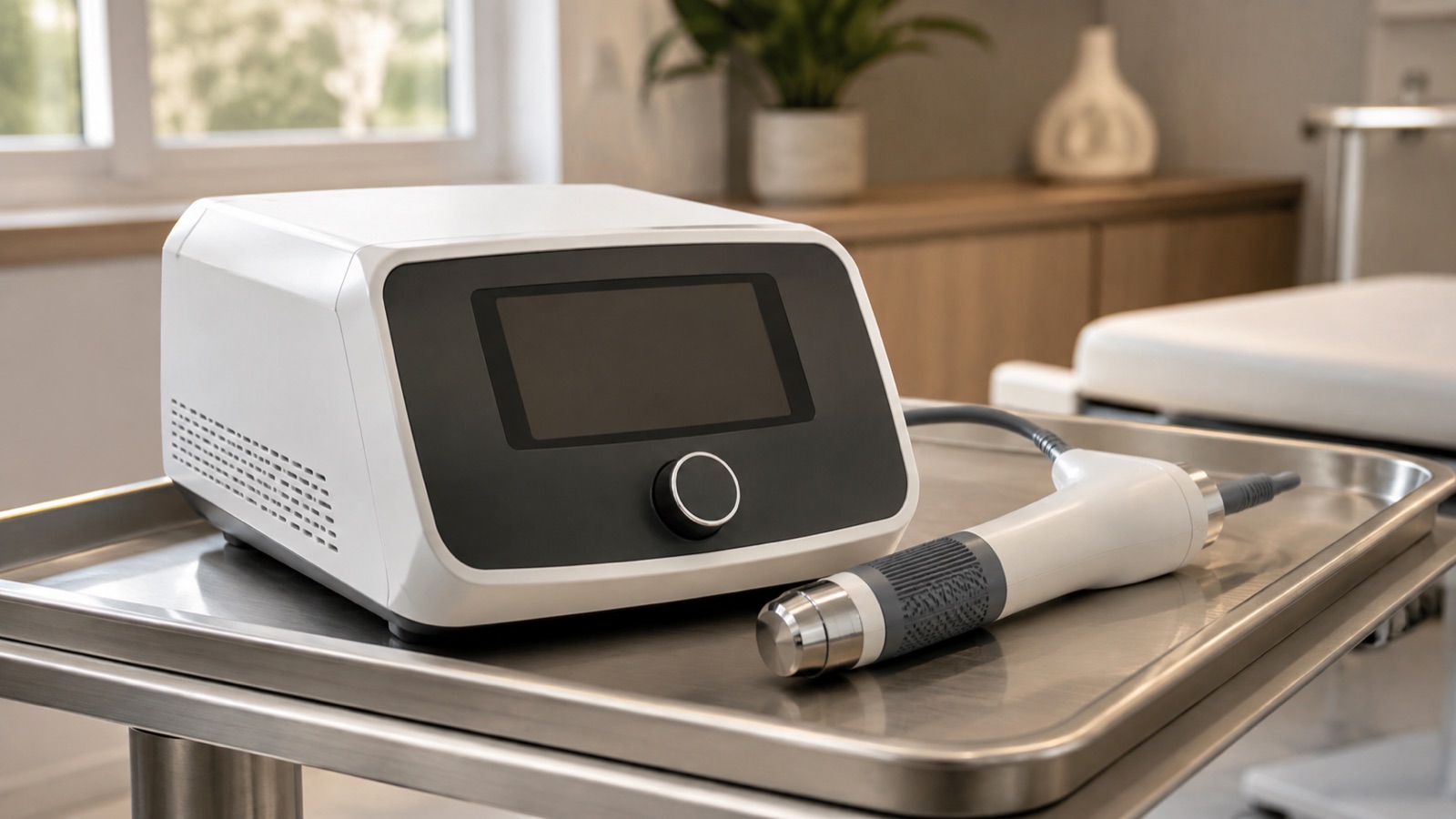
Shockwave therapy uses acoustic energy, short pulses of mechanical force, delivered through a handheld clinical device held against the skin. At low intensities, these pulses are used to stimulate localized tissue activity. The mechanism being studied is angiogenesis: the formation of new blood vessels in treated tissue, along with the reduction of microfibrosis that accumulates in penile tissue over time and restricts function.
The "low-intensity" designation is important. Shockwave has been used at higher energies for decades to break up kidney stones and to treat calcific tendon conditions. The application for ED uses significantly lower energy settings. It is not intended to cause significant discomfort, does not require anesthesia, and does not involve any incision or injection.
Sessions are conducted in a clinical office setting. A provider applies the device to specific treatment sites, typically along the shaft and base, following a structured protocol. Each session takes roughly 15 to 20 minutes. Most men return to normal activity immediately afterward.
This is not a spa service or a wellness supplement. At DC Medical, shockwave therapy is a physician-administered protocol applied according to clinical judgment about your specific anatomy and history.
Who Tends to Be a Candidate
A physician evaluation is required before starting shockwave therapy for ED. There is no way to determine candidacy from a website or a self-assessment tool. What the evaluation looks for:
- Vasculogenic ED: If reduced blood flow to penile tissue is contributing to your ED, shockwave therapy is the approach physicians consider most directly relevant. A thorough evaluation helps identify whether this is a factor.
- Partial or declining response to oral medications: Men who once responded to PDE5 inhibitors but now find them less effective are commonly evaluated for shockwave therapy. The tissue-level mechanism may address what medication can no longer compensate for.
- Inability to use oral medications: Whether due to side effects or a contraindication, men who cannot use standard ED medications need other clinical options. Shockwave is one that does not depend on the same pharmacological pathway.
- Preference for a non-pharmaceutical approach: Some men simply want an evaluation of options that does not start with a prescription. That is a legitimate reason to seek a consultation.
Shockwave is not appropriate for everyone. Active pelvic infections, certain bleeding conditions, or specific anatomical concerns may affect whether the treatment is suitable. This is exactly why a consultation with a physician is the necessary first step rather than a self-directed process.
What a Course of Treatment Involves
A single shockwave session is not a full course of treatment. Clinical protocols involve multiple sessions over several weeks. The exact number and frequency depend on your physician's judgment and your response as treatment progresses. Protocols commonly discussed in the clinical literature range from 6 to 12 sessions, though the right structure for you is determined through evaluation, not a general recommendation.
At DC Medical, shockwave sessions are physician-administered or physician-supervised. The device is applied to specific sites, and the provider adjusts based on your response during the session. There is no recovery period and no restrictions on activity afterward.
Response to shockwave therapy, when it occurs, tends to develop over weeks rather than immediately. Some men report changes within the treatment window; others notice them in the weeks following the completion of a course. Because the mechanism involves tissue-level changes rather than an immediate pharmacological effect, the timeline is different from what you experience with an oral medication taken on demand.
How Shockwave Fits Into a Broader Men's Health Evaluation
At a men's health practice, shockwave for ED is rarely examined in isolation. The vascular and hormonal factors that contribute to erectile dysfunction are often connected to other things you may already be noticing: lower energy, changes in body composition, slower recovery, reduced drive, or disrupted sleep.
Testosterone levels, for example, are directly relevant. A man with undertreated low testosterone pursuing shockwave therapy alone may be addressing one factor while leaving another unexamined. DC Medical evaluates hormone levels as part of a comprehensive men's health assessment rather than treating each symptom in a silo.
Other tools available alongside shockwave at DC Medical include exosome P-Shots, which deliver regenerative factors via injection, hyperbaric oxygen therapy for circulation and cellular recovery, and hormone optimization through the practice's HRT program. These are not interchangeable and are not always appropriate in combination. The right configuration depends on your evaluation, your goals, and the clinical picture your physician sees.
For men who want to address multiple contributing factors under a single coordinated plan rather than pursuing each treatment separately, DC Medical offers the ULTIMALE program: a structured six-month protocol that combines hormone optimization, 12 shockwave sessions, exosome P-Shots, Botox P-Shots, and 30 hyperbaric oxygen sessions. It is designed for men who want a comprehensive approach rather than a starting point.
How DC Medical Approaches This in Franklin, MA
DC Medical's men's health services are built around four connected areas: hormone optimization, regenerative medicine, longevity, and concierge primary care. Shockwave therapy for ED sits within the regenerative medicine pillar, offered alongside deep tissue laser, exosome injections, hyperbaric oxygen, and red light therapy as physician-administered protocols, not add-ons from a wellness menu.
Dr. David Cunningham evaluates each patient's full picture before recommending any treatment. That means reviewing your health history, any relevant labs, current medications, and what you are actually experiencing, rather than defaulting to a single protocol for anyone who mentions ED. The goal is a plan calibrated to you, not a checklist applied uniformly.
The practice serves men from Franklin and the surrounding towns of Wrentham, Foxboro, Norfolk, Mansfield, Sharon, Canton, Walpole, Bellingham, Medway, Easton, North Easton, and Norton, Massachusetts. Consultations are available both in person at the Franklin office and virtually through the practice's hybrid care model.
Dr. David Cunningham · 693 East Central Street, Suite 100, Franklin, MA 02038 · Virtual & in-office
Frequently asked questions
Does shockwave therapy for ED hurt?
At the low-intensity settings used for erectile dysfunction, most men describe the sensation as noticeable but not painful. You will hear a clicking sound from the device and feel the pulses, but significant discomfort is uncommon. If you have concerns about tolerating the procedure, bring them up at your consultation before starting treatment. The physician can walk you through exactly what to expect during a session.
How many sessions are typically needed?
There is no single universal protocol. Most clinical programs involve 6 to 12 sessions spread over several weeks, with the number and frequency determined by the treating physician based on your response. A single appointment is a consultation and evaluation, not a complete course of treatment. Your physician will give you a realistic picture of what a full protocol looks like for your situation, not a generic estimate.
Can shockwave therapy help if oral ED medications have stopped working as well as they used to?
This is one of the clinical situations where shockwave therapy is most often discussed. Oral medications work through the vascular system you have. Over time, if tissue-level changes are reducing the available baseline, the medication has less to amplify. Shockwave therapy targets the tissue level directly rather than working through the same pharmacological pathway. Whether it is appropriate for you depends on what is actually driving your ED, which is something a physician evaluation establishes. No general answer replaces that assessment.
Where is DC Medical located, and how do I reach them?
DC Medical is located at 693 East Central Street, Suite 100, Franklin, MA 02038. The practice serves men from Franklin and surrounding towns including Wrentham, Foxboro, Norfolk, Mansfield, Sharon, Canton, Walpole, Bellingham, Medway, Easton, North Easton, and Norton. You can reach the office at (508) 593-9673 to ask about scheduling a consultation with Dr. David Cunningham. Initial consultations can be conducted in person or virtually depending on your preference and what the evaluation requires.
This article is for general education and is not medical advice or a substitute for a consultation. Programs, candidacy, and outcomes vary by individual and are determined during a physician evaluation with Dr. David Cunningham. Pricing reflects DC Medical's current published programs and may change.